
Node Reference
Introduction
Section titled “Introduction”In conventional prompt engineering, adjusting tone and behavior often relies on natural-language modifier phrasing (“act as an expert,” “think step by step”). Such phrasing tends to be ambiguous and often introduces meta-instruction noise alongside the task itself.
MTP replaces much of that control with non-verbal metadata: coordinates and axis labels compiled into tiered constraints. This page separates the core semantics of each Side A / Side B node from the prompt-output tendencies produced by the current MTP Skill.
Core semantics describe the direction represented by a node across applications. Prompt-output tendencies describe how that direction is currently translated into LLM behavior.
Node quick reference
Section titled “Node quick reference”Each color axis in MTP has two nodes: Side A and Side B (each referred to as <node>).
Intensity (<intensity>) can be specified in the range 0 to 100.
Side A is the positive-side node and can be specified by node name, such as power:70 (<node>:<intensity>). Side B is the inverse-side node and can be specified by node name, such as void:70.
When using a color name instead of a node name, positive values activate Side A and negative values activate Side B.
For example, red:70 activates Power, while red:-70 activates Void.
The same polarity rule applies to node names: power:-70 also activates the Red axis through Void.
Side A quick reference
Section titled “Side A quick reference”| Color / Axis | Node | Usage example | Core semantics | Prompt-output tendencies | |
|---|---|---|---|---|---|
| Yellow | open | open:100 / yellow:100 / D:4 | Opening, possibility, expansion | Divergent ideation, option generation, leaving room for choice | |
| Red | power | power:100 / red:100 / J:4 | Force, assertion, drive | Firm claims, decisions, persuasive conclusions | |
| Magenta | return | return:100 / magenta:100 / P:4 | Return, reversal, recurrence, reframing | Critique, counter-reading, reframing a premise | |
| Green | grow | grow:100 / green:100 / D:10 | Development, layering, widening | Expanded explanations, elaboration, branching ideas | |
| Transparent | helix | helix:100 / transparent:100 | Integration, unfolding structure, interrelation | Traceable reasoning, linked steps, visible structure | |
| White | focus | focus:100 / white:100 / P:10 | Precision, clarity, definition | Specification checks, evidence, narrowed scope | |
| Cyan | enter | enter:100 / cyan:100 / D:16 | Threshold, entry, framing | Introductions, onboarding, explicit scope and prerequisites | |
| Blue | flow | flow:100 / blue:100 / J:16 | Continuity, connection, rhythm | Smooth prose, transitions, readable progression | |
| Purple | close | close:100 / purple:100 / P:16 | Closure, completion, sealing | Summaries, conclusions, next actions |
Side B quick reference
Section titled “Side B quick reference”| Color / Axis | Node | Usage example | Core semantics | Prompt-output tendencies | |
|---|---|---|---|---|---|
| Dark Yellow | still | still:100 / yellow:-100 / A:1 | Restraint, preservation, suspension | Formatting, proofreading, minimal change, suppressing new suggestions | |
| Dark Red | void | void:100 / red:-100 / J:1 | Absence, subtraction, hollowing, silence | Shortening, removing noise, dry or minimal responses | |
| Dark Magenta | surge | surge:100 / magenta:-100 / S:1 | Release, excess, eruption, overflow | High-energy writing, dense accumulation, forceful expression | |
| Dark Green | wither | wither:100 / green:-100 / A:10 | Attenuation, pruning, decline | Key-point summaries, concise explanations, reduced branching | |
| Translucent (Transparent) | collapse | collapse:100 / transparent:-100 | Compression, convergence, loss of structure | Direct answers, simplified summaries, flattened organization | |
| Dark Grey (White) | haze | haze:100 / white:-100 / S:10 | Ambiguity, diffusion, obscured definition | Poetic language, atmosphere, softened distinctions | |
| Dark Cyan | drift | drift:100 / cyan:-100 / A:19 | Deviation, wandering, loosened direction | Free association, tangents, lateral development | |
| Dark Blue | abyss | abyss:100 / blue:-100 / J:19 | Depth, descent, weight | Deep reflection, criticism, dense analysis | |
| Dark Purple | fade | fade:100 / purple:-100 / S:19 | Attenuation, dissolution, afterimage | Open-ended prose, tapering conclusions, lingering resonance |
Side B color names are not the opposite color (White does not flip to Black); they restate the axis color to match each node’s meaning. Haze is White growing hazy toward grey, shown as “Dark Grey (White),” and Collapse is Transparent breaking down, shown as “Translucent (Transparent).”
Axis structure
Section titled “Axis structure”This section briefly organizes how each axis relates within the taxonomy.
- Vertical (Red ↔ Blue): The axis where directions that stress assertion and structure face directions that preserve receptivity and continuity.
- Horizontal (Green ↔ White): The axis where outward expansion while holding outline faces narrowing the subject for rigorous scrutiny.
- Corners (Yellow, Magenta, Cyan, Purple): Transitional gradient regions that connect adjacent nodes of the cross.
- Center (Transparent): A neutral node placed between opposing directions.
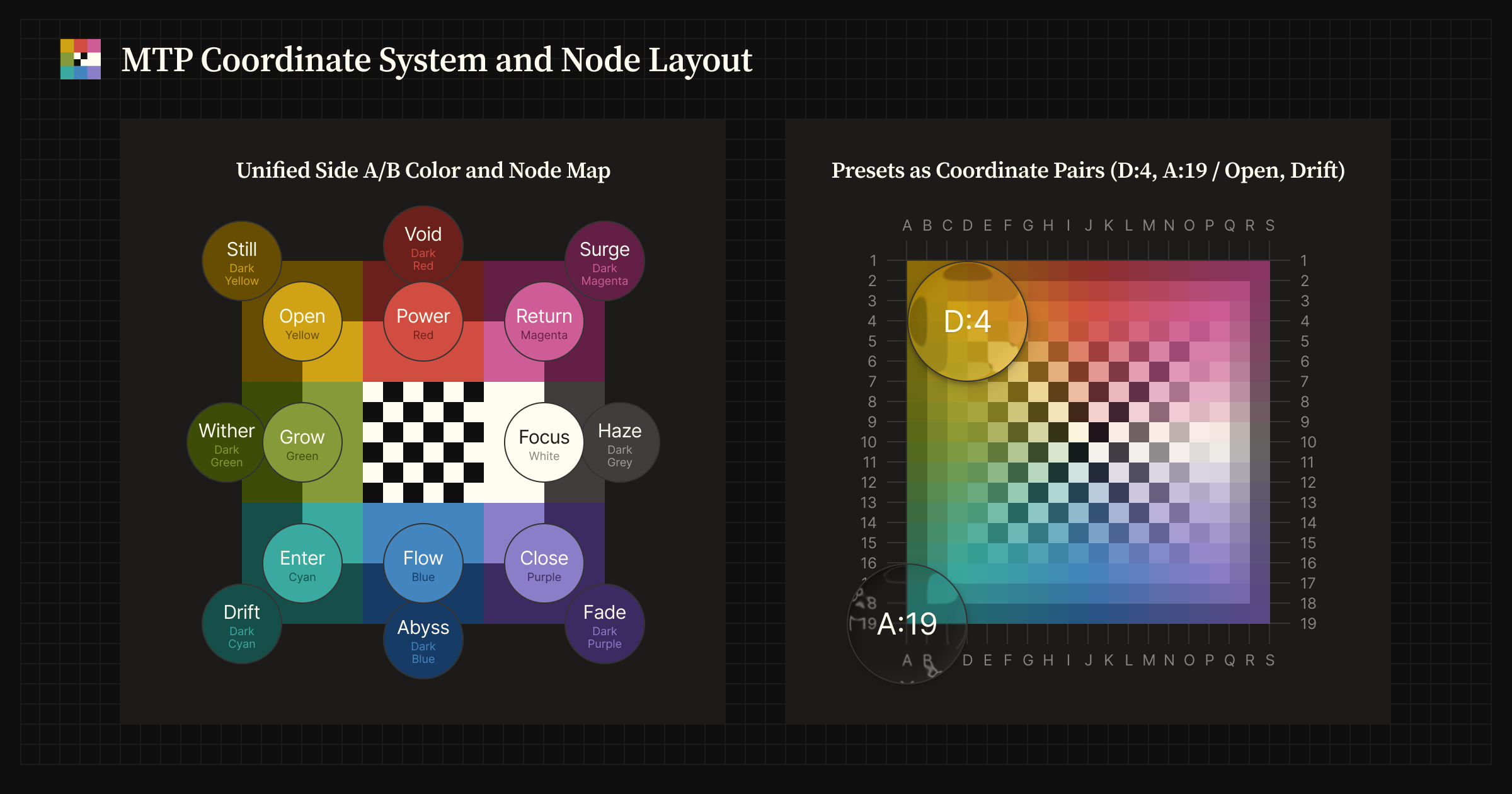
The axis layout can be read both as a 3x3 Side A / Side B map and as coordinate positions on the 19x19 grid.
Side A / Side B
Section titled “Side A / Side B”As an output tendency, Side A often appears as a force that moves the response forward. In an introduction, for example, it may invite the reader in, add reasons, structure the material, sharpen focus, or carry the text toward a conclusion.
Side B is not simply a weaker Side A. As the inverted pole of the same axis, it often shifts output away from construction toward reduction, away from clarity toward ambiguity, away from expansion toward descent, and away from closure toward afterimage. Side B is not the “bad” or “low” side; it functions as the shadow or reverse face of the axis.
Side B interpretation
Section titled “Side B interpretation”Under the Chebyshev-based radial rule, coordinates on the outer perimeter frame flip to Side B for that zone. In constraint design, Side B is expressed as an inverted pole of the same axis: a paired opposite in a yin-yang sense (for example, Power → Void, Focus → Haze, Grow → Wither).
Side B suits cases that call for a stronger extreme along that axis or more compressed surface wording, with the same model-to-model variability as Side A.
Combining nodes and presets
Section titled “Combining nodes and presets”MTP can also specify multiple nodes at the same time to blend output tendencies. Instead of switching output with a single node, it can layer several axes like a gradient, such as combining assertion (power:20) with precision (focus:30), or development (grow:20) with readability (flow:50).
The idea is to reduce the burden of operation by combining MTP nodes intuitively, while still changing the model’s output tendency in a controlled way.
When several MTP tokens are present, each token is still resolved under the same Space / Intensity rules; the compiler emits one constraint block per token in parse order (the order they appear in the payload).
That order is not a third parameter space or a dedicated “motion” layer. The sequence may be read as a semantic trajectory on the grid, but that is an optional design reading only.
Named sliders (power:100, flow:70) are an easy starting point when meaning should stay readable; grid coordinates suit cases where the visible message should remain short.
Named presets expand to fixed coordinate sequences defined in skills/mtp/references/presets.yaml; they can be applied to reproducible multi-step blends.